

Why this memo exists
This memo exists for one reason:
To anchor my thinking about GigaCloud Technologies (GCT) to first principles, not price, headlines, or quarterly noise.
I will reread this before earnings, before adding, and before selling.
If my future actions contradict what’s written here, I should be able to point to new facts, not emotions.
My entry: acknowledging the advantage I already have
I began buying GCT at an average price of $17.98 per share.
At the time:
Enterprise value was roughly $800M
Unlevered free cash flow (UFCF) implied a ~14% yield
The business was priced like a low-quality logistics operator
The market was ignoring the emerging 3P marketplace + logistics flywheel
I was effectively buying:
a profitable, capital-light business, debt free
with real cash generation
at ~7× UFCF
The subsequent re-rating to ~$40/share was not luck - it was the market correcting a misclassification.
That advantage exists only once.
The decision today is not “was I right?”
It is:
At ~$40/share (~$1.6B EV), does GCT still offer attractive forward returns?
What kind of business GCT actually is
GCT is not:
a pure marketplace
a pure logistics company
a pure distributor
It is a hybrid, logistics-first marketplace, and that order matters.
For decades, GCT operated as a 1P business, learning how to:
move bulky goods
manage fulfillment density
control last-mile delivery
operate warehouses profitably
Only in 2019 did the 3P marketplace emerge.
This matters because:
Most marketplaces struggle to add logistics
GCT added a marketplace on top of logistics that already worked
That inversion is the core competitive advantage.
The economic model (simplified, on purpose)
I do not model dozens of scenarios.
I model in-variants and bounds.
Economic gross profit today
3P marketplace: ~6% economic take on GMV
1P business: ~29% gross margin
Combined gross profit today is ~$250M
Corporate overhead
After stripping out operational costs embedded in COGS:
True corporate overhead ≈ $100M
This includes executives, finance, legal, core platform engineering
This distinction matters enormously.
Why 1P matters (and why it’s not a crutch)
Today, 1P gross profit still meaningfully supports free cash flow.
That is not a weakness.
It provides:
stability through freight cycles
predictable gross profit
downside protection while 3P scales
Importantly:
Management has not signaled any intent to exit 1P
Inventory continues to be allocated where ROIC makes sense
This is closer to Costco (Kirkland) or Amazon (Amazon Basics) than to a pure marketplace ideology.
The long-term inflection point I am watching is:
When 3P gross profit alone fully covers corporate overhead.
At that point:
1P becomes optional capital allocation
the business qualitatively de-risks
free cash flow convexity increases
Current valuation: what the market is saying
At ~$40/share:
Market cap ≈ $1.5B
Enterprise value ≈ $1.6B
Unlevered FCF ≈ $114M
EV / UFCF ≈ 14×
UFCF yield ≈ 7.1%
A 14× UFCF multiple implies the market believes:
GCT is durable
cash flows will exist
but growth will be modest
and economics will remain logistics-like
This is not a distressed valuation.
It is also not a compounder valuation.
That framing is crucial.
The floor: what has to go wrong to lose money
My floor case assumes:
3P economic take remains ~6%
service margins do not recover meaningfully (~12% today)
1P margins compress slightly but remain profitable (29% → 27%)
corporate overhead grows conservatively to ~$150M over a decade
no multiple expansion
no buybacks
Even under those assumptions:
UFCF remains roughly flat to modestly growing
shareholder returns land around 7–9% annually
This is the bond-like floor.
Permanent capital loss would require:
structural failure of logistics economics
loss of seller ROI
or severe capital misallocation
I do not see evidence of that today.
The base case: why this is still attractive
My base case requires favorable but not heroic outcomes.
It assumes:
long term 3P GMV growth in the mid-teens
long term 1P GMV growth in the high single digits
3P economic take stays flat at ~6%
1P gross margin stays ~27–29%
corporate overhead growing slower than GP (~4%)
no dramatic margin expansion
Under this framework:
UFCF compounds in the high single digits
combined with a 7% starting yield
total returns reach ~12–15% without multiple expansion or share buybacks
That is a solid outcome for a business with bounded downside.
The upside case: where returns become asymmetric
The upside is not driven by valuation.
It is driven by economics.
If:
3P GMV sustains 18–20% growth (again, 24% YoY LY)
1P grows 5–7% (again, 34% YoY LY)
blended gross profit compounds at ~12%
corporate overhead remains disciplined (~$140–150M)
Then over a decade:
gross profit approaches $800M
EBIT approaches $650M
Unlevered free cash flow approaches $450M
At that point:
even a conservative multiple implies substantial upside
returns reach the high-teens to low-20s IRR
This scenario does not require:
Amazon-level margins
advertising
SaaS miracles
It requires:
logistics density
seller ROI
and time
Buybacks: the quiet return accelerator
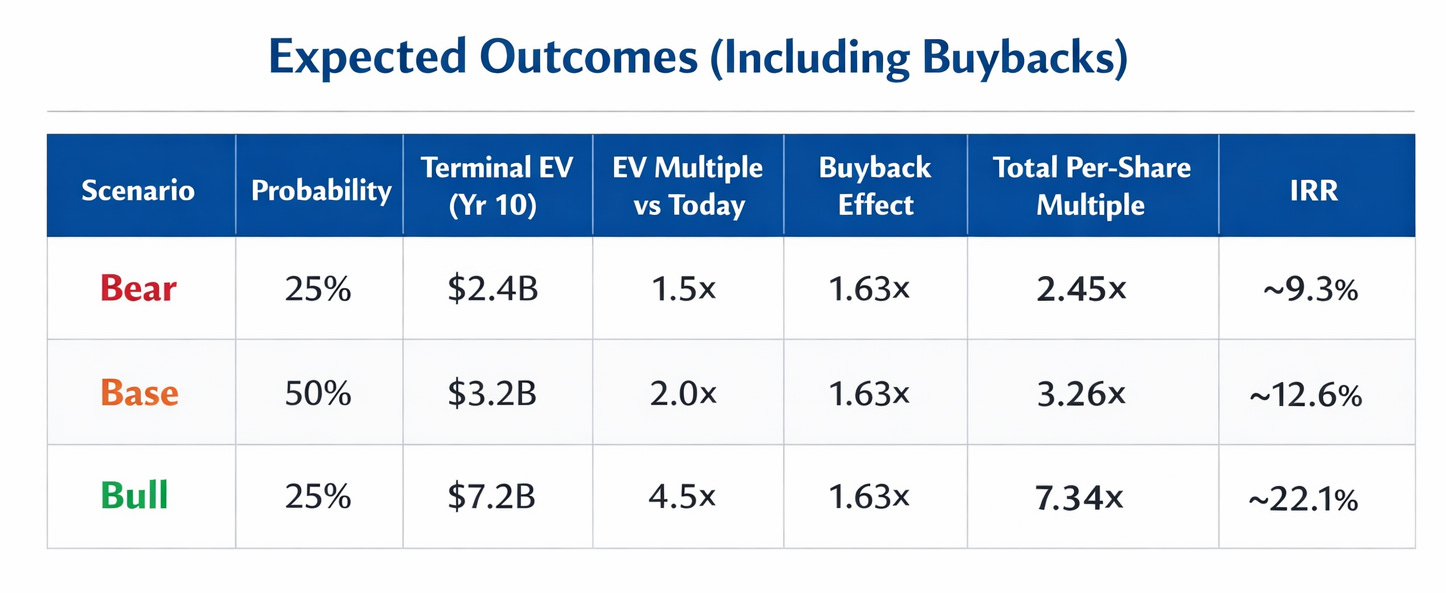
There is $95M remaining share repurchase authorization, roughly 6% of shares outstanding.
Larry Wu has demonstrated:
opportunistic repurchases
willingness to step in during volatility
owner-like capital allocation
At today’s valuation:
buybacks (if continued) add 2–3% annualized to per-share returns
without relying on growth or re-rating
This matters more now than it did at $18.
Rather than assuming a fixed annual repurchase rate, I assume GigaCloud has the capacity to retire approximately 4–6% of its share count annually over time when valuation and conditions permit. Over a decade, this translates into a meaningful increase in per-share ownership, even if execution is uneven.
Scenario Table
The decision framework at ~$40
This is no longer a deep value trade.
It is a compounder-with-optionality decision.
Hold: easy yes
downside is bounded
business quality intact
Add modestly:
if 3P growth remains >15%
if corporate overhead stays disciplined
if platform commission continues to creep
Add aggressively:
only on dislocation
or explicit capital return acceleration
I do not need to force action.
What would make this memo wrong
I should reconsider if I see:
Downside Scenario (25% probability):
- 3P economic take: 6% (flat, no recovery)
- 3P GMV growth: 10% CAGR (cohorts underperform)
- Exit multiple: 9x (market remains skeptical)
- 2035 FCF: $200M
- 2035 EV: $1.8B
- Return: 1.2% CAGR + 3% buyback = 4.2% total
This is my “permanent capital loss” threshold.
structural deterioration in seller ROI
persistent overhead bloat
abandonment of capital discipline
evidence that logistics density is not compounding
Absent those, time is working in my favor.
Closing thought
I bought GCT cheaply once.
That opportunity is gone.
What remains is something rarer:
A profitable, founder-led, capital-light business with real cash flow, bounded downside, and credible paths to upside.
At today’s price of approximately $40 per share, GigaCloud trades at an enterprise value of roughly $1.6 billion. After revisiting my valuation framework, I estimate the business’s present intrinsic enterprise value at approximately $2.9 billion. This estimate assumes UFCF grows from roughly $114 million today to approximately $450 million over the coming decade, applies a 15× terminal UFCF multiple, and discounts both the intervening cash flows and terminal value back to the present at my 15% required rate of return. On this basis, the market is valuing GigaCloud at roughly 55 cents on my estimate of the dollar of intrinsic value.
Importantly, the ~$2.9 billion figure represents my estimate of intrinsic value today, not what I expect the business to be worth a decade from now. If the underlying economics develop as expected, intrinsic value should itself continue to compound as free cash flow grows. This creates two potential sources of return: the closing of the current gap between price and value, and the continued growth of intrinsic value while I wait. Share repurchases made materially below intrinsic value can further increase each remaining shareholder’s claim on the business, although I view repurchases as a use of the free cash flow already incorporated into my valuation rather than as a separate source of return.
In summary, at approximately $40 per share, I believe I am purchasing GigaCloud at roughly 55 cents on the dollar of present intrinsic value while owning a business whose intrinsic value has the potential to compound meaningfully over the coming decade. I do not know when, or whether, the market will fully recognize that value. I do not need it to happen quickly. If the business compounds as I expect and management continues to allocate capital rationally, time itself should do much of the work.
Disclaimer
This memo reflects my personal investment framework and opinions. It is not investment advice. I may be wrong, and circumstances can change. I reserve the right to change my mind as new facts emerge.

Thank you. Rigourous analysis like this anchors proper valuation.